
Services
Strength & asymmetry
The AllDreams strength and asymmetry assessment measures force, jumps and the difference between the left and right side with VALD systems, and comes with an ALLDREAMS medical board report.
- Price
- Ask us for a price · per athlete
- Who it is for
- Clubs and school teams, priced per athlete
- Where
- At the club, school or clinic · 45–60 minutes
- How often
- 2–3 times a season; every 8–12 weeks during a programme
What it is
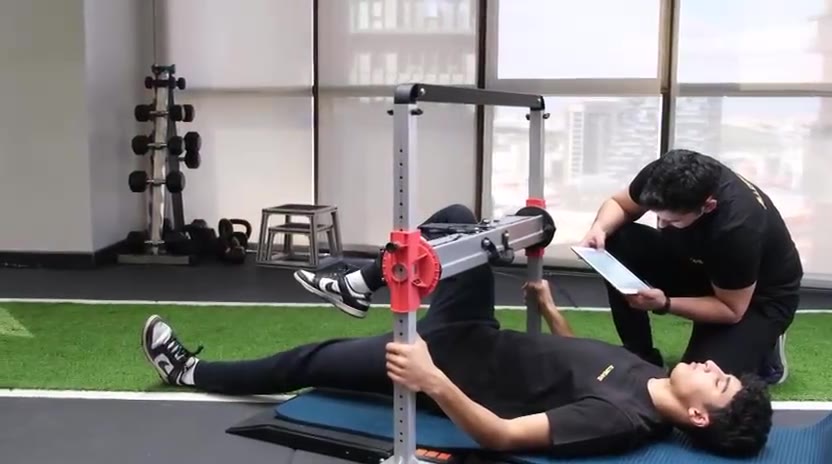
ForceDecks, NordBord and ForceFrame measure jump, landing, hamstring and hip strength for each side separately. A physician and a physiotherapist read the results with the athlete's history.
What you get
- Jump and landing force on ForceDecks force plates
- Hamstring strength on NordBord and hip strength on ForceFrame
- HumanTrak and SmartSpeed tests, analysed in VALD Hub
- Each side measured separately, so a difference between them shows
- An ALLDREAMS medical board report, read with the athlete's history
The assessment
Each side measured. One report, read by clinicians.
VALD systems measure the left and the right side separately, so a difference between them shows. A physician and a physiotherapist read the results with the athlete's history, and the ALLDREAMS medical board report goes to the record.
01The stations
- ForceDecksJumps and landing, left and right
- NordBordHamstring strength, each side
- ForceFrameHip strength, each side
- HumanTrak and SmartSpeedMovement and sprints, in VALD Hub
At the club, school or clinic · 45–60 minutes
02The medical board report
03Who reads it
- The athlete's recordThe report, next to every earlier test, ready for the next control.
- The athlete and the parentsLeft and right side by side, in plain words.
- Coach and health staffOnly with the family's consent: what to work on, side by side.
A finding is a reason to look closer, not a diagnosis
The devices
VALD systems. Each one measures something else.
VALD is an Australian measurement company whose systems are used by professional clubs, national teams, university sport and elite training centres. The assessment draws on them, chosen for the sport and the athlete's history.
-
Dual force plates
ForceDecks
Two plates measure the force of each leg in jumps, landings and balance: jump height and power, how fast the athlete stabilises, and which leg does how much of the work.
-
Hamstring testing
NordBord
Eccentric hamstring strength of each leg during the Nordic exercise, and the gap between the two. Developed at Queensland University of Technology.
-
Isometric strength
ForceFrame
Upper- and lower-body strength in more than 30 positions: hip adductors and abductors, knee extension, shoulder rotation.
-
Timing gates
SmartSpeed
Wireless gates for speed, agility and reaction tests, with splits shown at once in the app and on each gate.
-
Handheld dynamometer
DynaMo
Pull and push force, grip strength and range of motion in one device, for tests across the major joints.
-
3D movement analysis
HumanTrak
Markerless 3D motion capture, set up in under five minutes: joint range of motion, left–right differences and compensations, rep by rep.
-
Velocity-based training
GymAware
Bar speed and power on every repetition, and the change from one session to the next at the same load.
-
Cloud platform
VALD Hub
Every measurement in one place, compared with normative data from millions of tests: a percentile for the athlete's age and sex, over time.
The standard battery
Extended for the sport and the athlete's history. Each value is reported in its unit (newtons, centimetres, seconds) and as a percentile.
| Test | System | What it shows |
|---|---|---|
| Countermovement jump | ForceDecks | Explosive power and jump height |
| Drop jump · RSI | ForceDecks | Reactive strength: the jump against ground-contact time |
| Land and hold | ForceDecks | Time to stabilise on landing, and the share of each side |
| Single-leg land and hold | ForceDecks | Control on one leg, for the knee and the ankle |
| Nordic hamstring | NordBord | Eccentric hamstring strength, left and right |
| Knee extension | ForceFrame | Quadriceps strength and the difference between sides |
| Hip adduction and abduction | ForceFrame | The balance of the groin muscles |
| Shoulder rotation | ForceFrame | Rotator-cuff balance, for overhead sports |
| Hip extension | ForceFrame | Hip drive and the posterior chain |
VALD and the names of its systems are trademarks of VALD. AllDreams uses the systems and does not own them.
What measuring changes
Numbers instead of a hunch.
-
A gap you cannot feel shows
Each side is measured at the same time and on its own, so a strength difference between the legs shows long before the athlete would notice it.
-
Return to play on measurements
Side-to-side ratios and pain-free range of motion sit beside "I feel fine". Clinicians make the decision.
-
Where performance is lost
High strength with a below-average jump says the issue is using force quickly, not producing it, and that changes the programme.
-
Training for each athlete
Two players in the same team rarely need the same work; the measurements show who needs what.
-
Progress you can see
After an 8–12-week programme the re-test shows the change in centimetres and percentages, not in impressions.
-
One language for coach and physio
The coach wants to load, the physiotherapist wants to protect. A shared table of measurements takes the debate out of opinion.
Who it is for
- Clubs and school teams, priced per athlete
- Academies and schools, on their screening days
- Companies, in on-site screening programmes
How it works
- 01
Book
Your club, school or academy books the assessment for its athletes.
- 02
Measure
At the club, school or clinic, in 45–60 minutes.
- 03
Read
A physician and a physiotherapist read the results with the athlete's history.
- 04
Repeat
2–3 times a season, and every 8–12 weeks during a programme.
Price
per athlete
Tell us about your athlete or your team and we reply with a price. An institution's agreement may include it, discount it or fix its price.
Where the result goes
The result lands on the athlete's one record, next to every test, report and clinic note. Only the people the athlete allows can see it, or a parent for an athlete under 18. A coach, a health team and a partner clinic each need their own consent, which can be withdrawn at any time.
Measurements, genetic and biometric insights describe tendencies. They are not diagnoses, do not replace clinical examination and do not determine athletic outcomes. AllDreams gives wellness and performance information and is not a medical device. Diagnosis and treatment are done by licensed clinicians at DHA-licensed partner clinics.
Questions
How long does the assessment take?
45 to 60 minutes, at the club, the school or a clinic.
How often should it be repeated?
2–3 times a season, and every 8–12 weeks while the athlete follows a programme, so the change can be checked.
Who reads the results?
A physician and a physiotherapist read them with the athlete's history. A finding is a reason to look closer, not a diagnosis: diagnosis stays with the doctors at partner clinics.
Do the tests hurt?
No. They are non-invasive and stay within the range the athlete tolerates. A test limited by pain is not reported as low strength: it is marked as not valid and repeated.
Is it worth it if the athlete is not injured?
Yes. Measuring shows gaps before a complaint appears, and the first test sets a personal baseline to compare against later.
Does the assessment prevent injury?
No. No test guarantees against injury or predicts it with certainty; injuries have many causes. Measurement makes the gaps that can be worked on visible, and clinicians and coaches decide what to do about them.
Is it suitable for children?
Yes. The tests are used safely with growing athletes and help follow their development from one season to the next.
What does it cost?
Ask us for a price · per athlete. Tell us about your athlete or your team and we reply with a price. An institution's agreement may include it, discount it or fix its price.
Related services
All servicesBring it to your academy, school or club.
Sign up and start today. Need a tailored plan or agreement? Talk to us.